
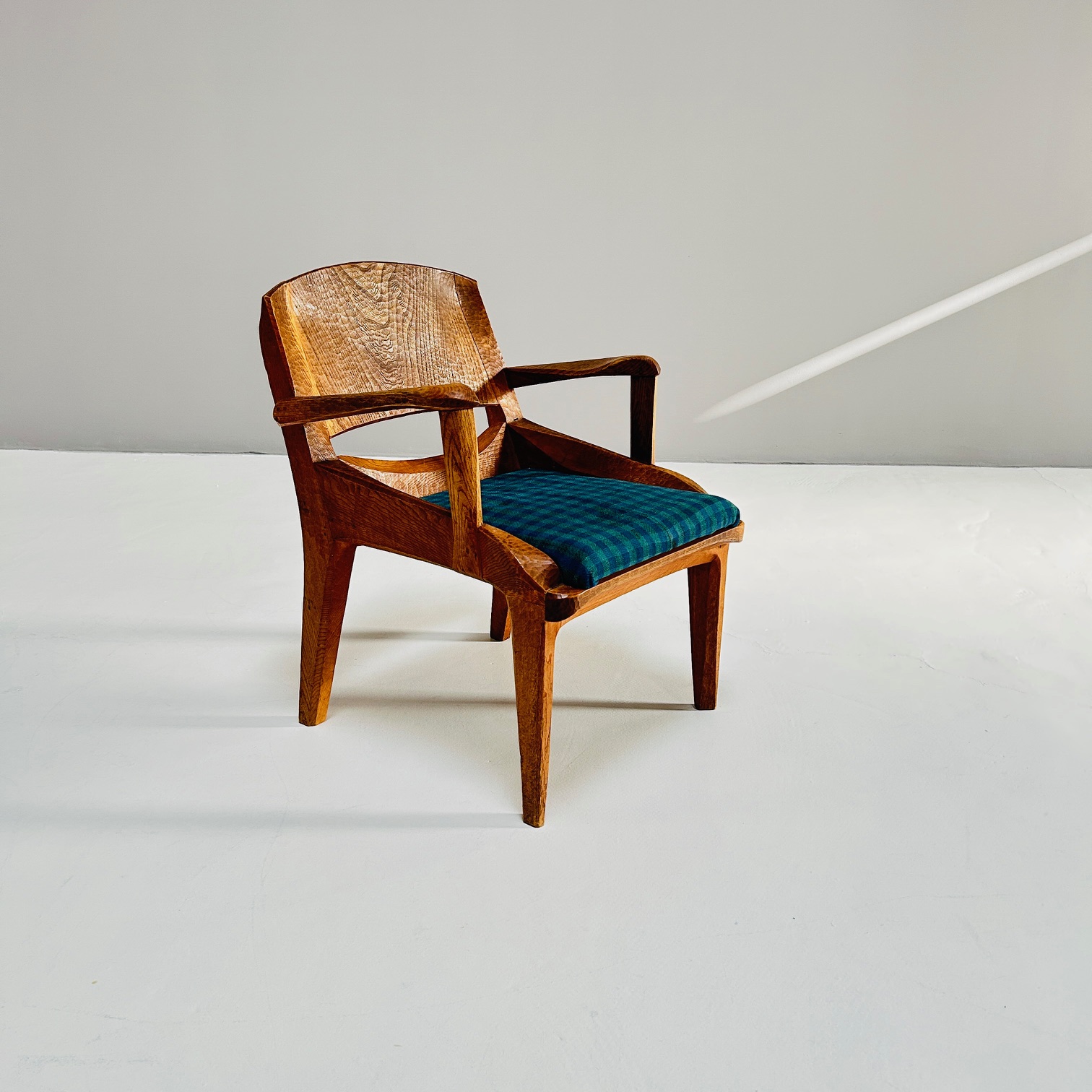
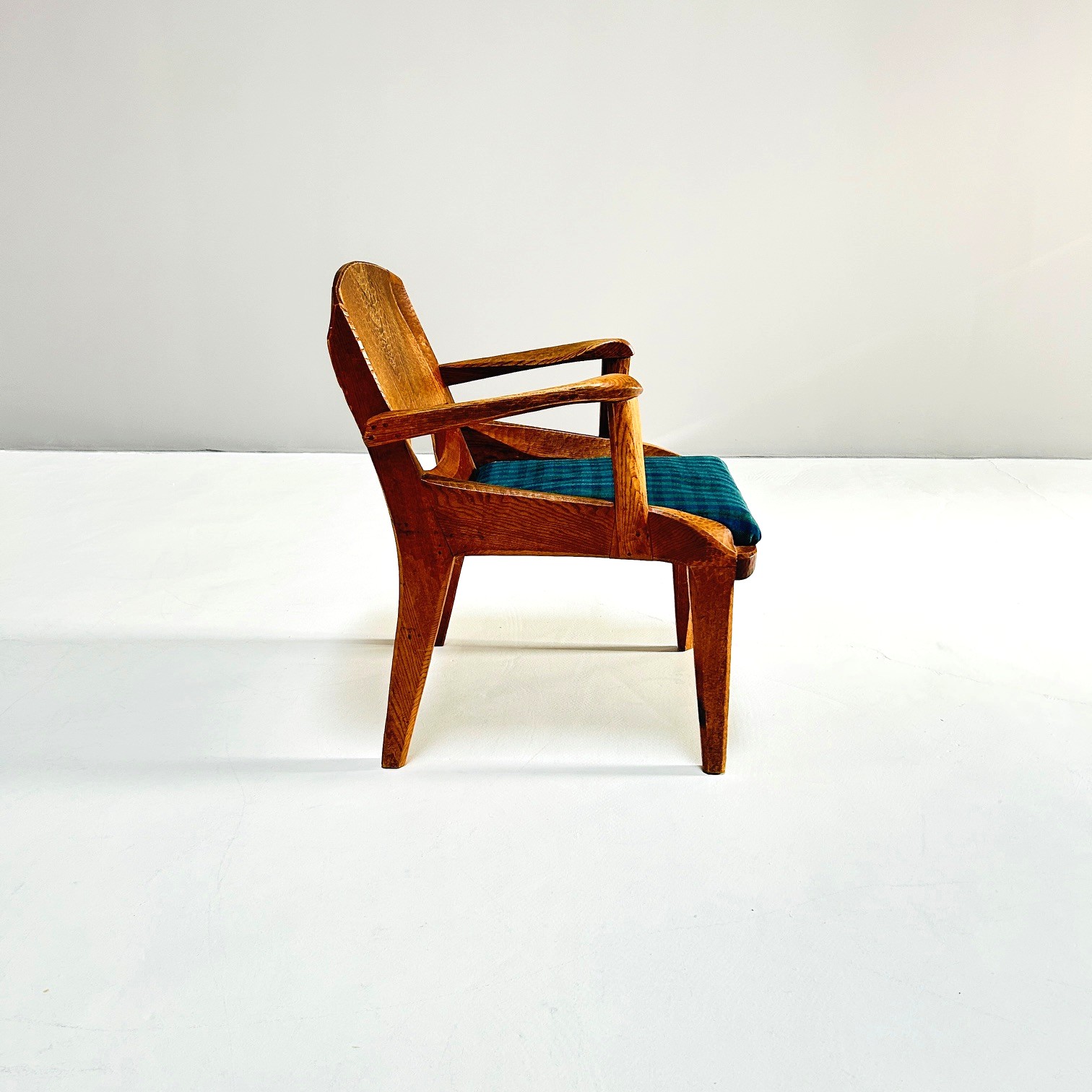
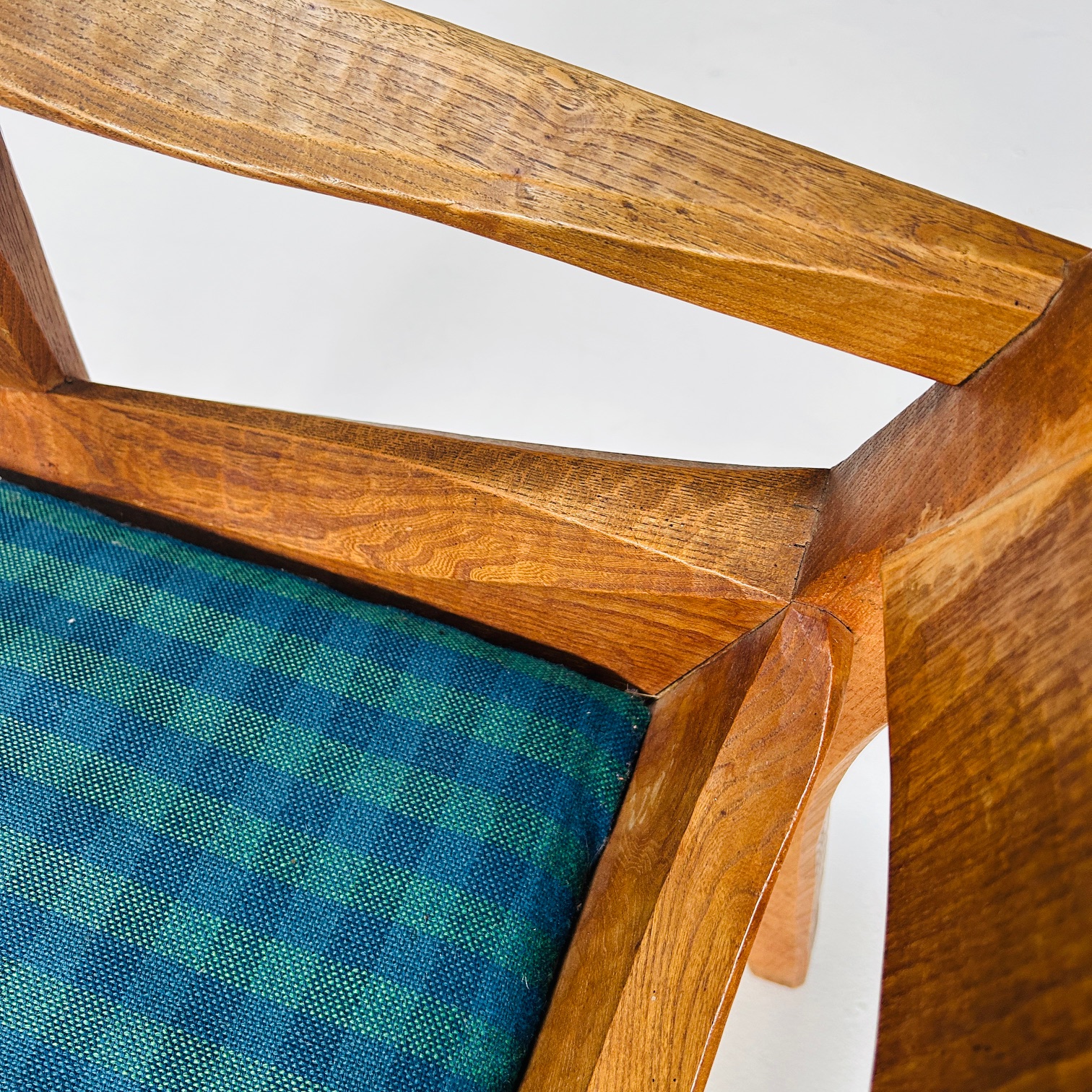
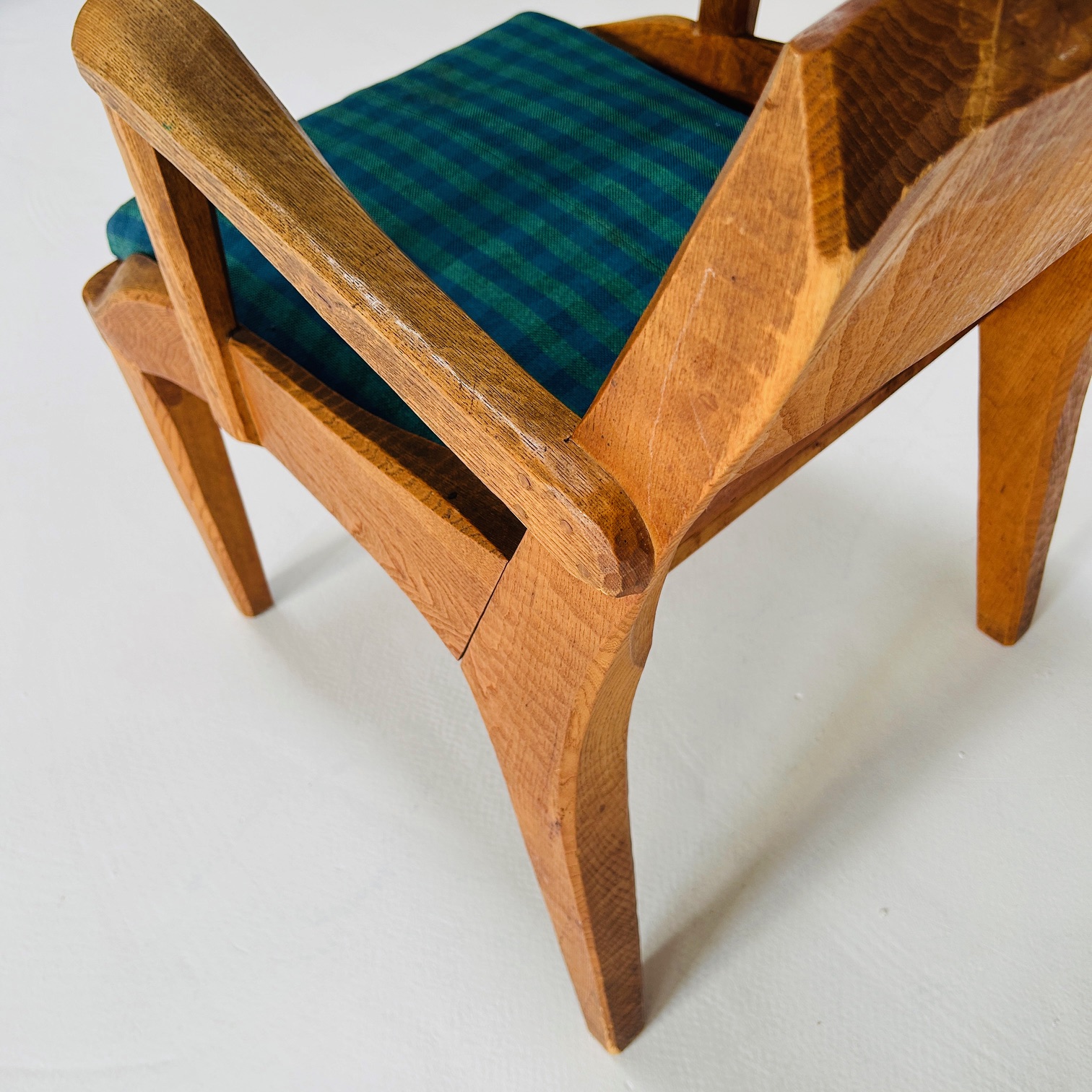
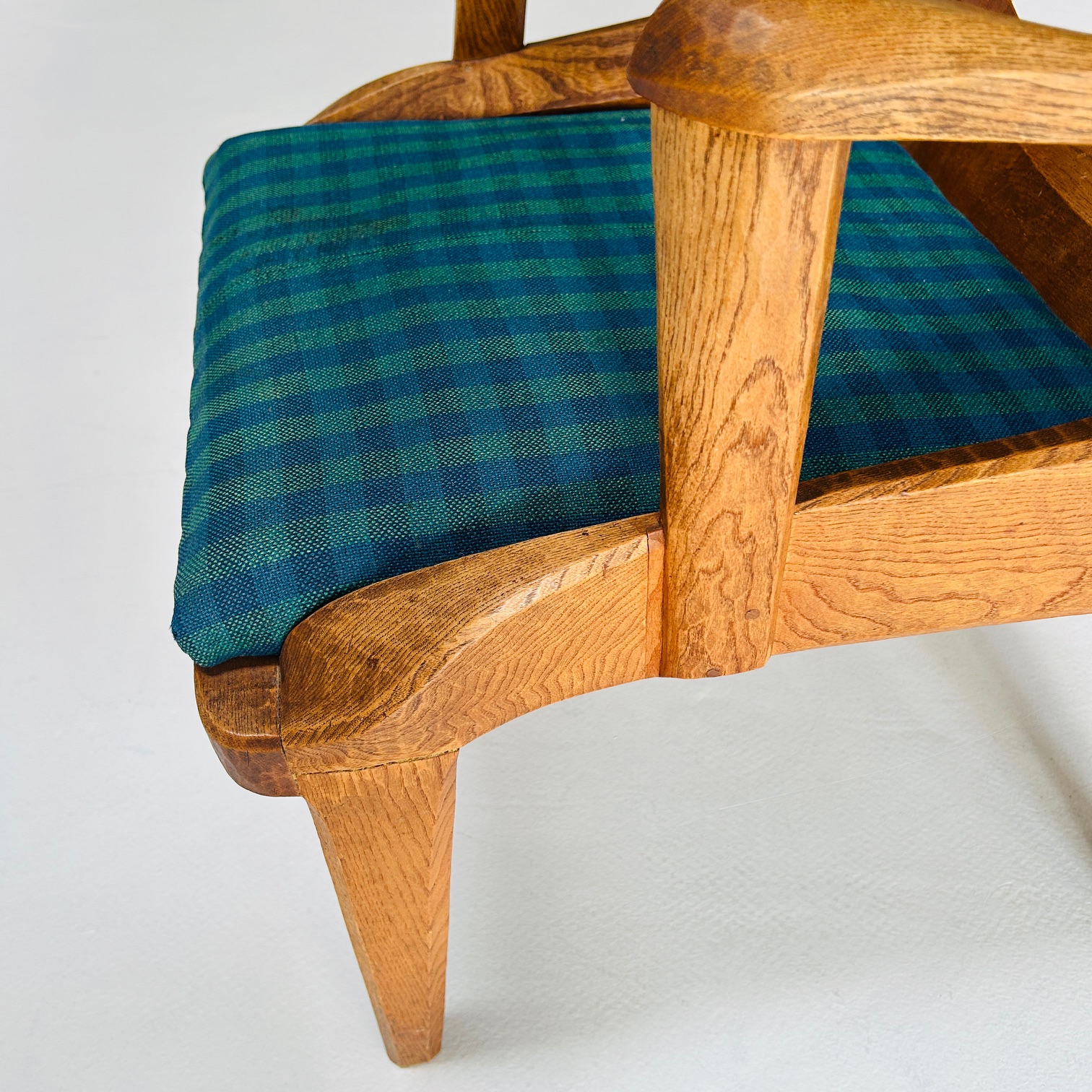
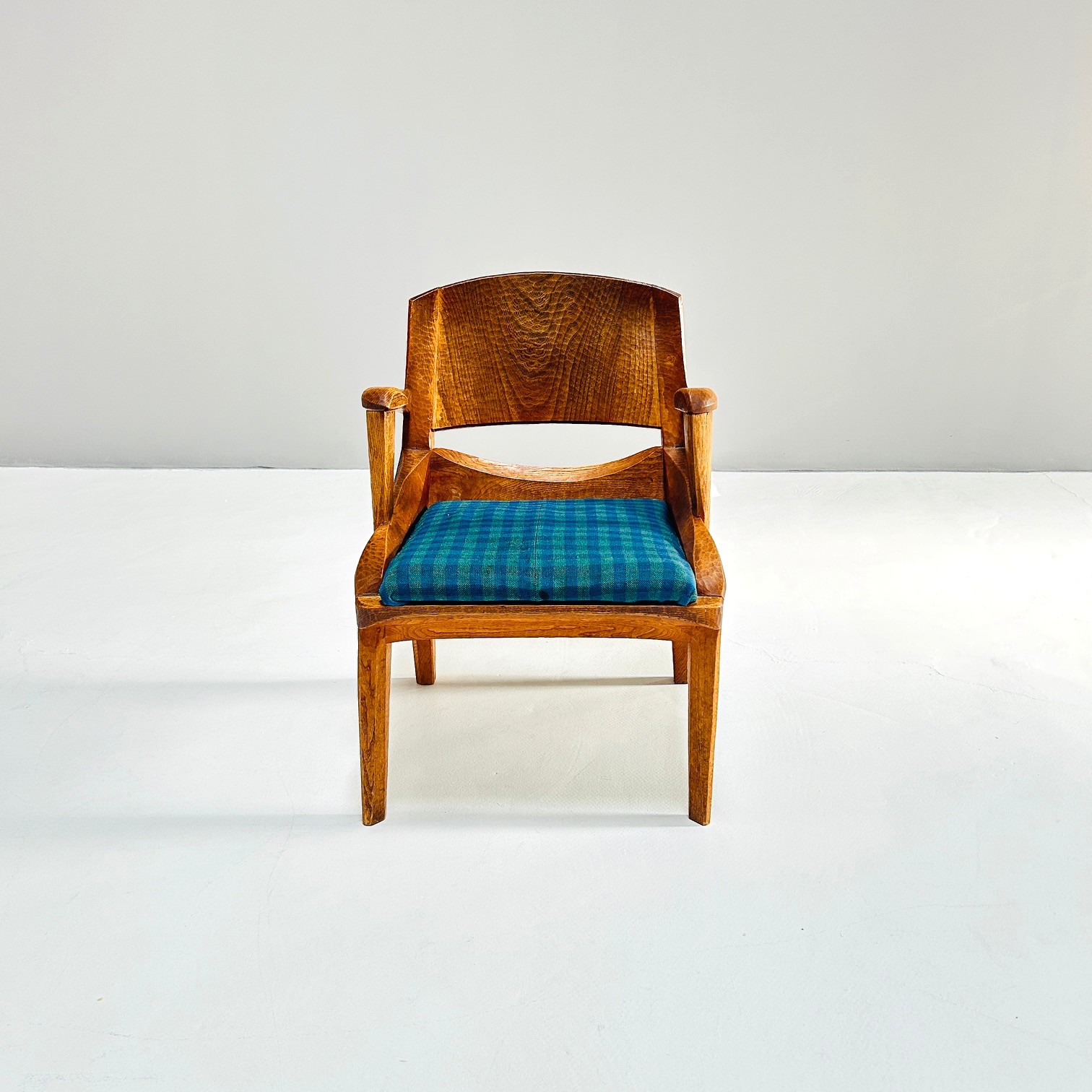
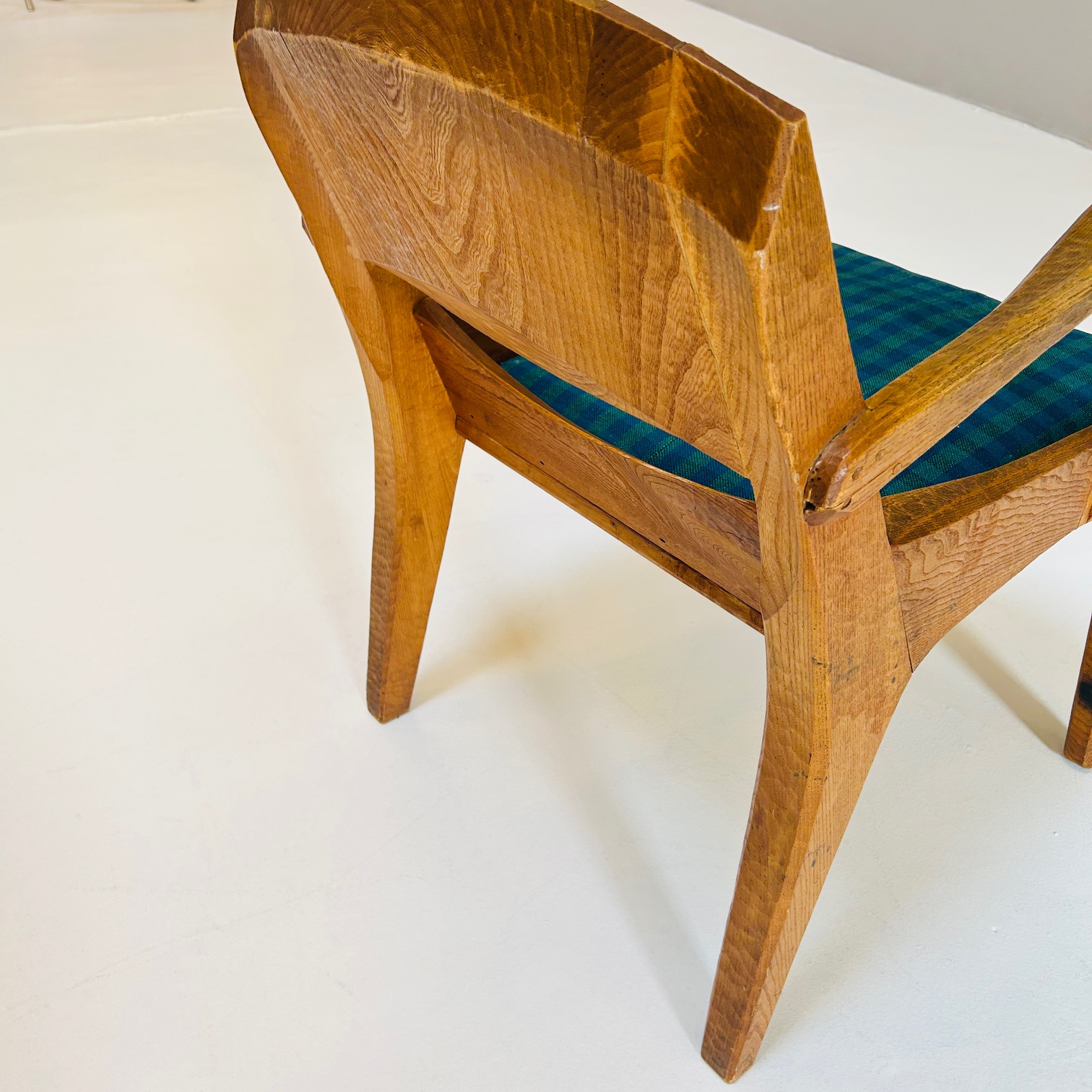
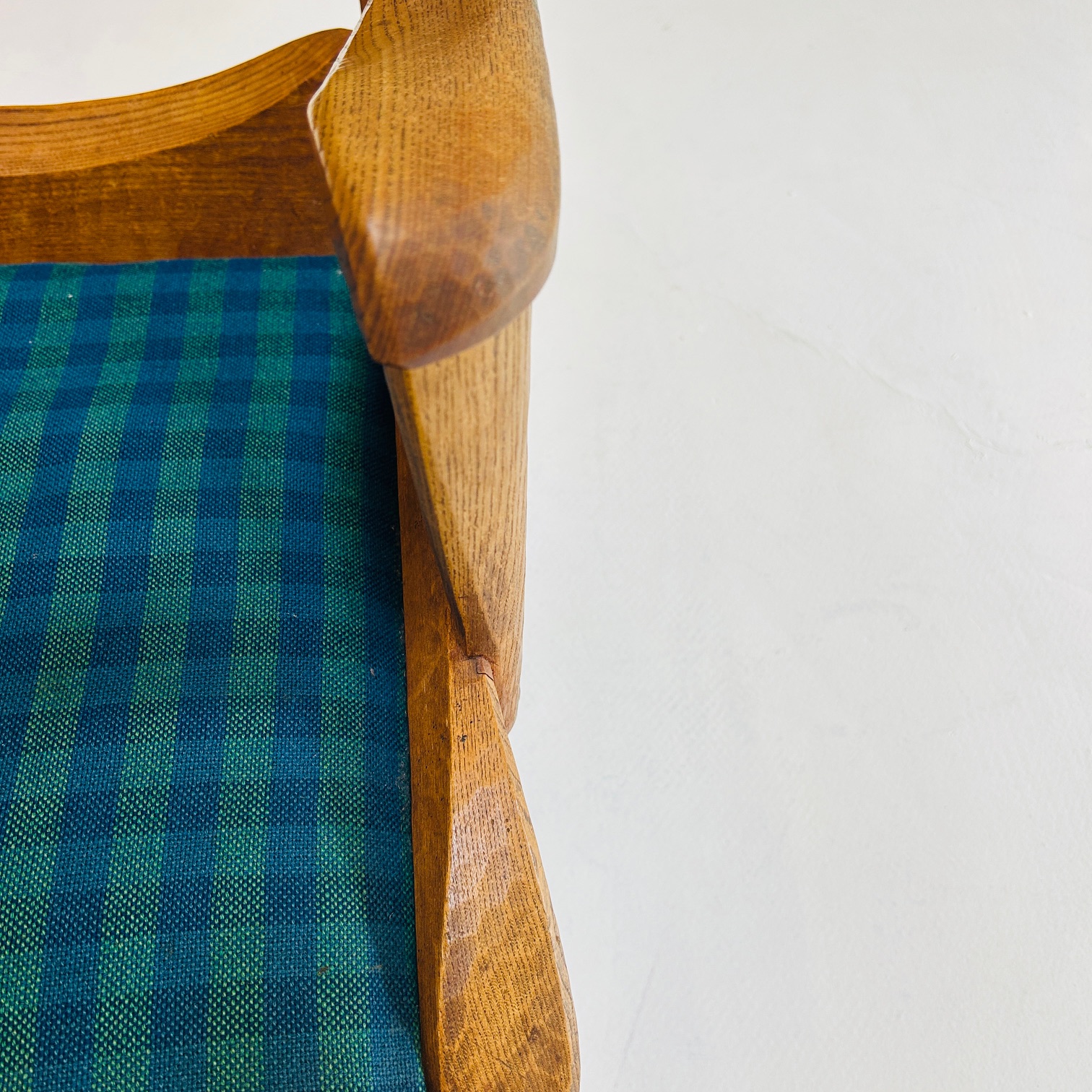
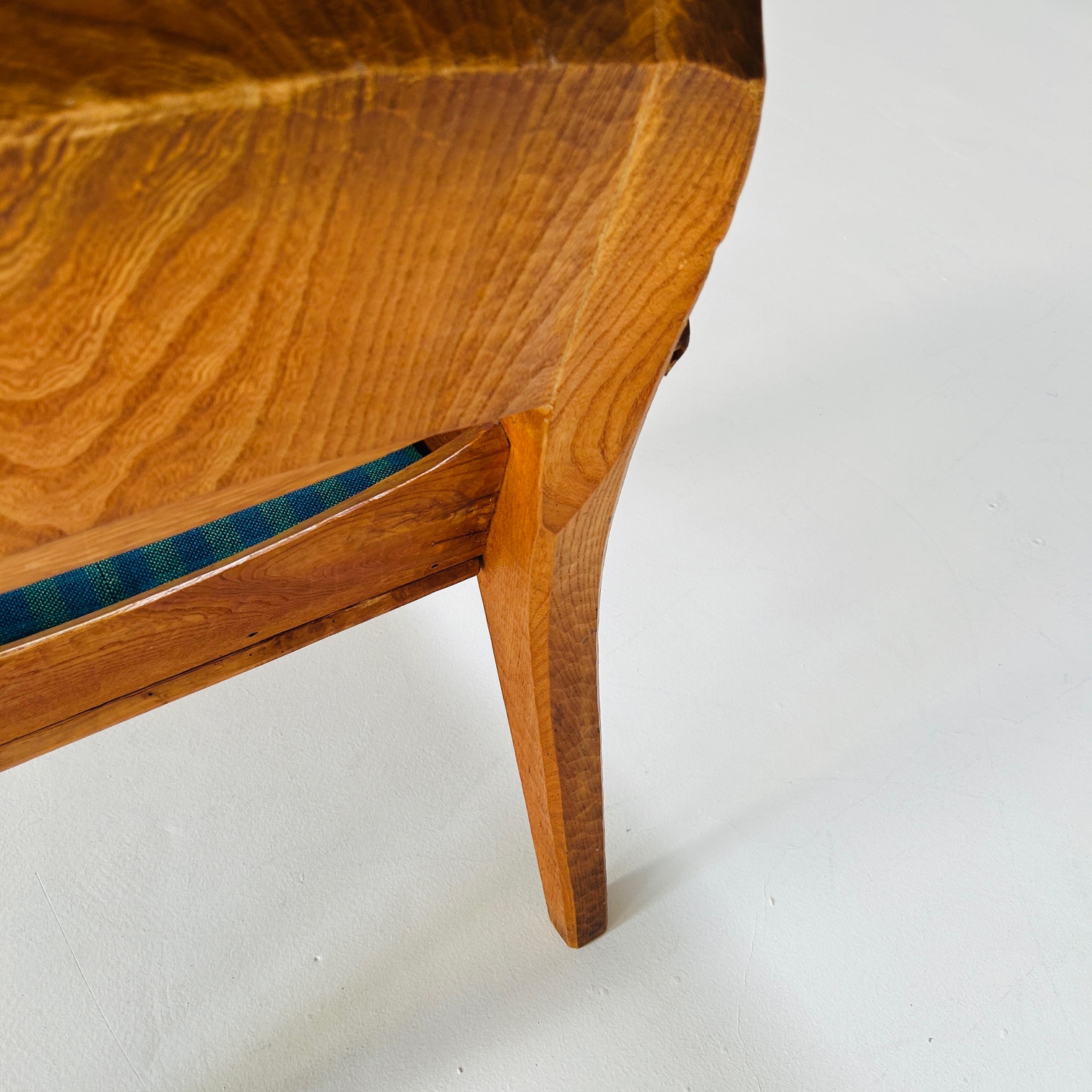
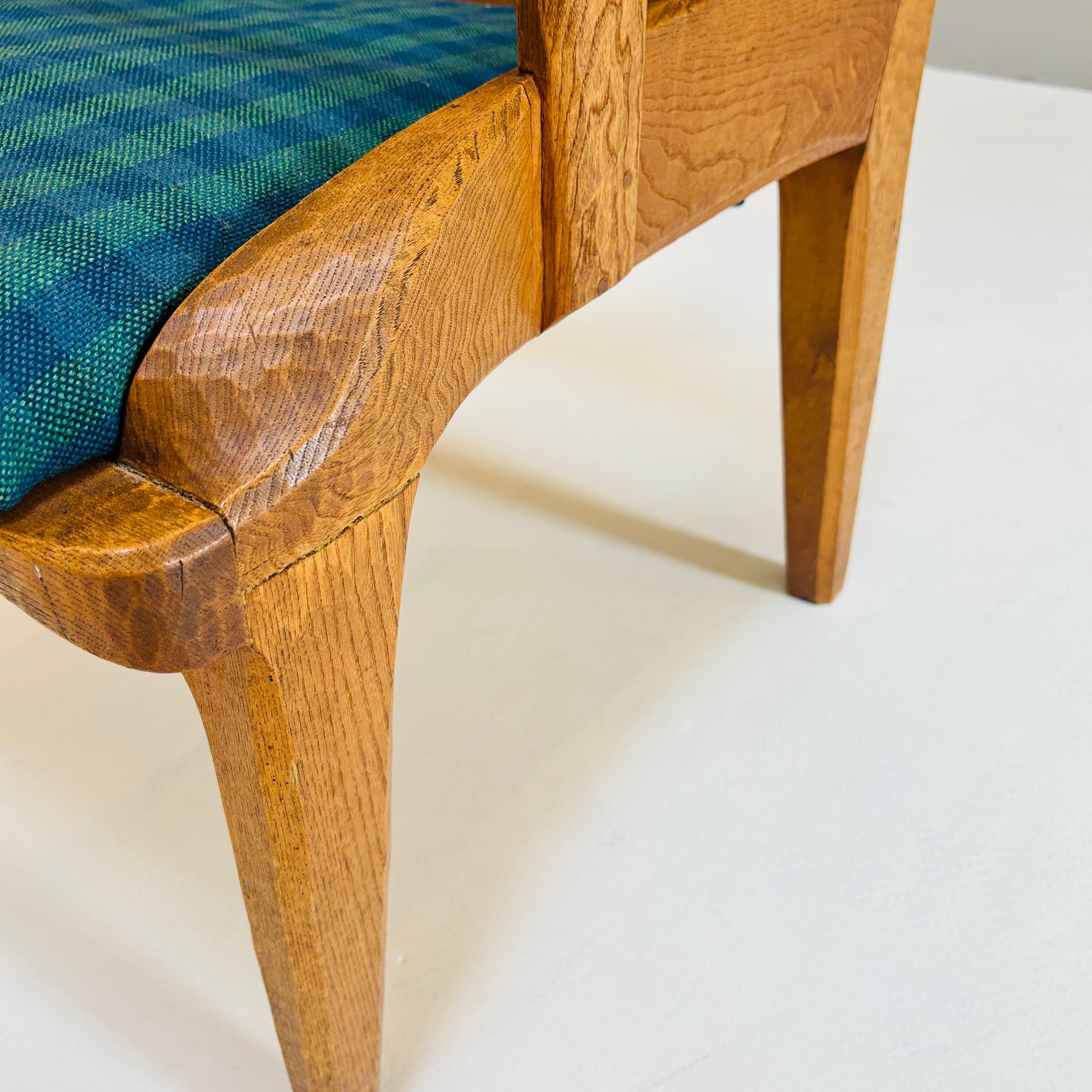
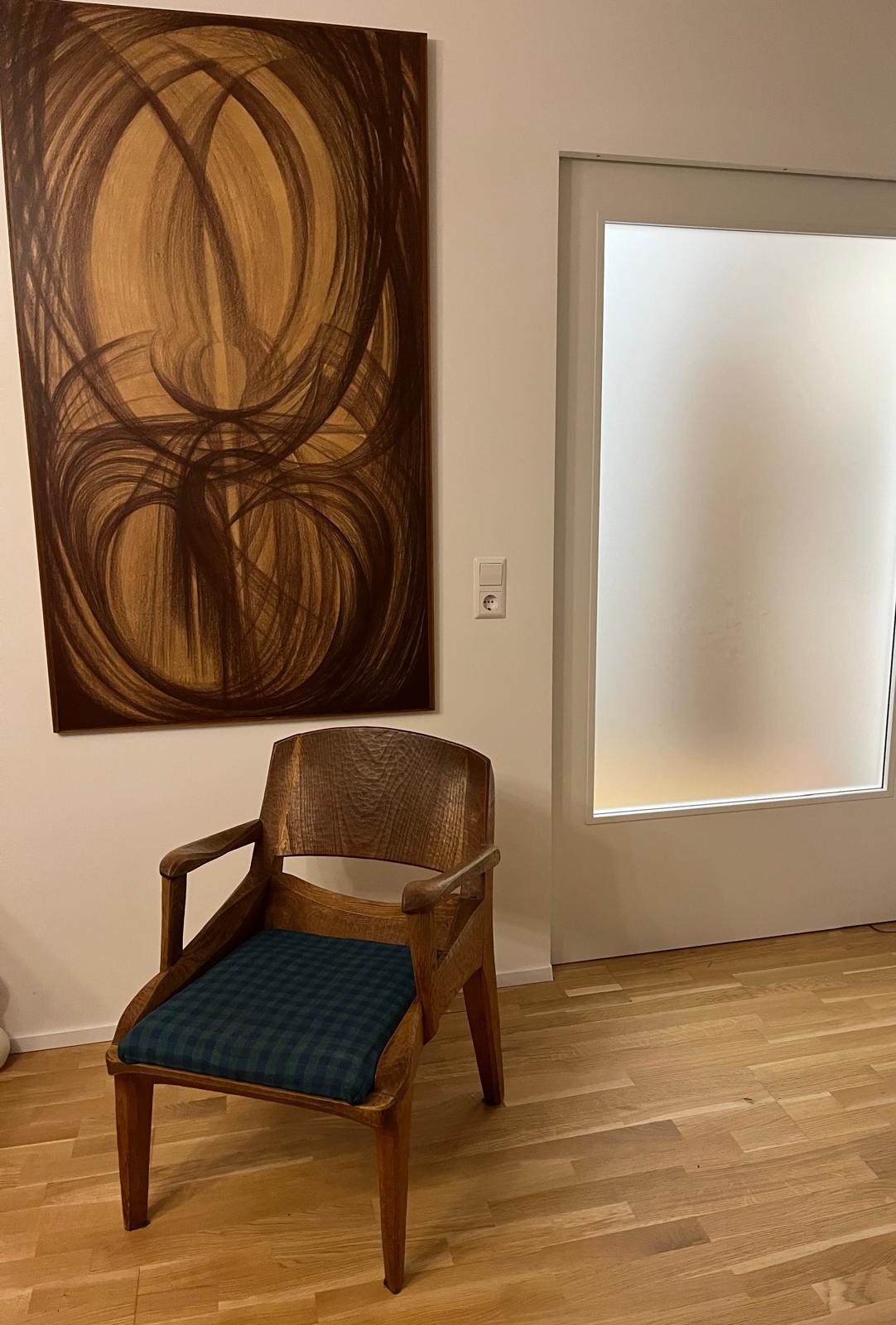
Siegfried Pütz, armchair from the artist’s private collection, around 1940
PRICE ON REQUEST
The armchair was created between 1930 and 1945, when artist and designer Siegfried Pütz was banned from working during the Nazi regime.
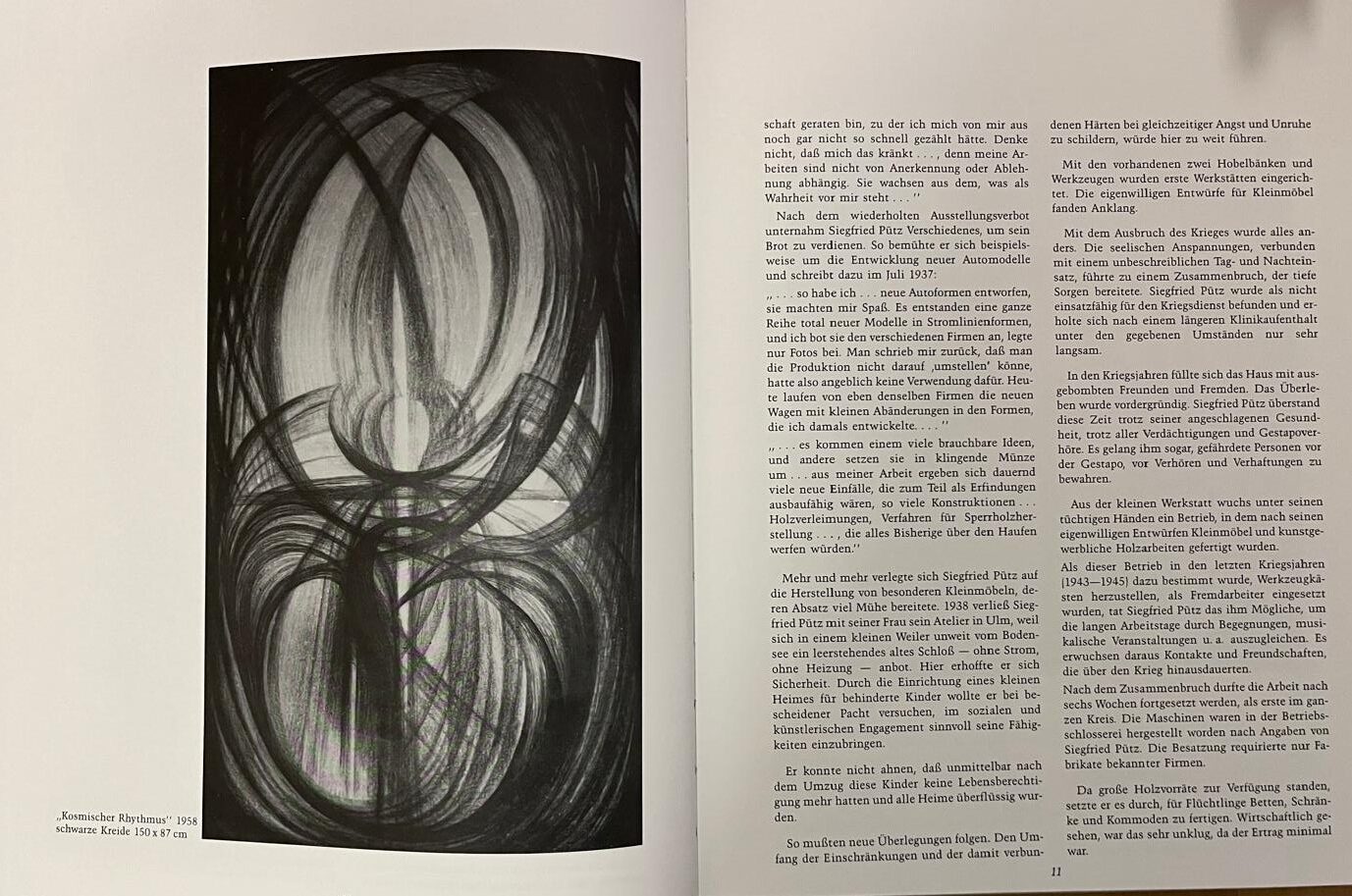
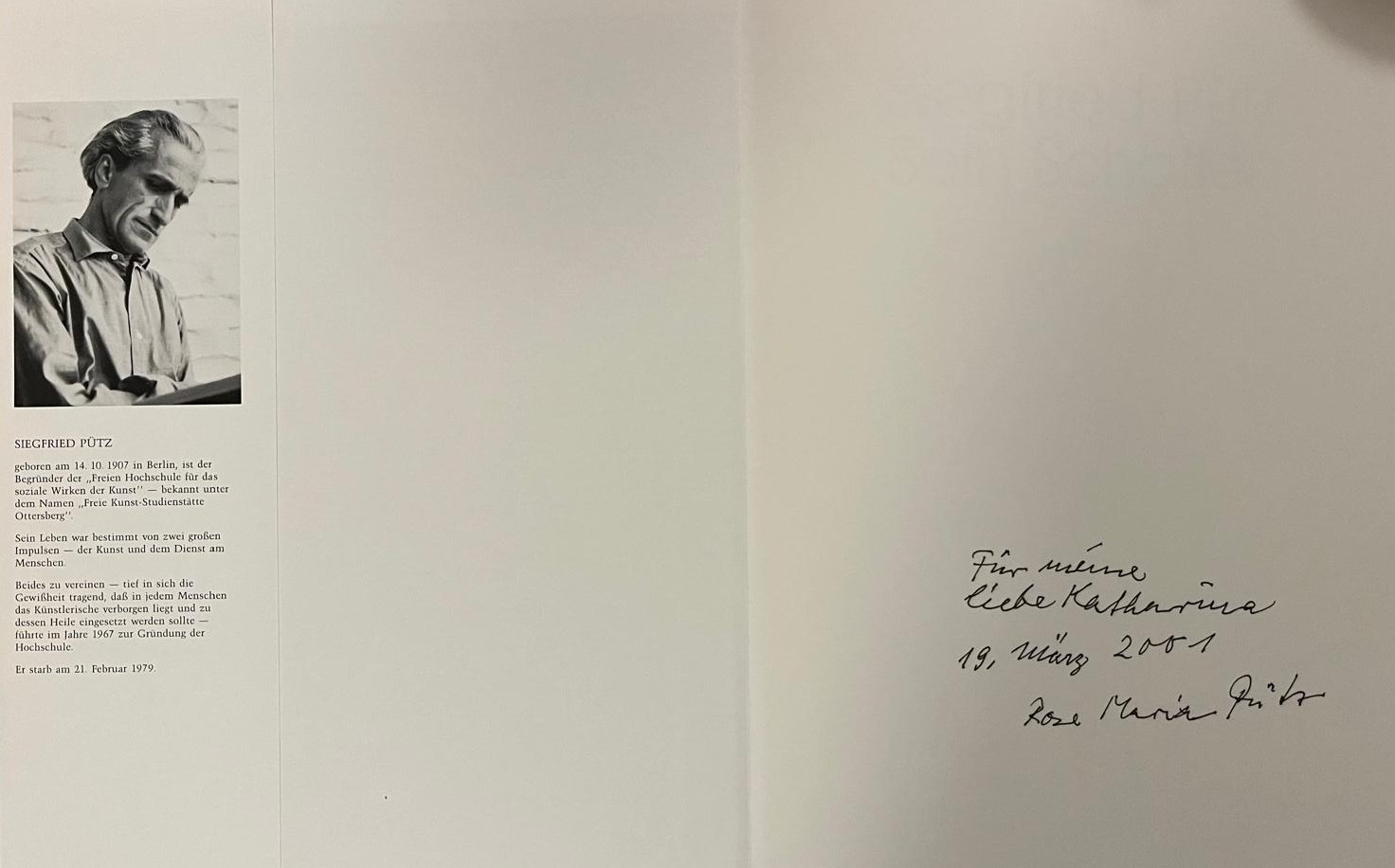
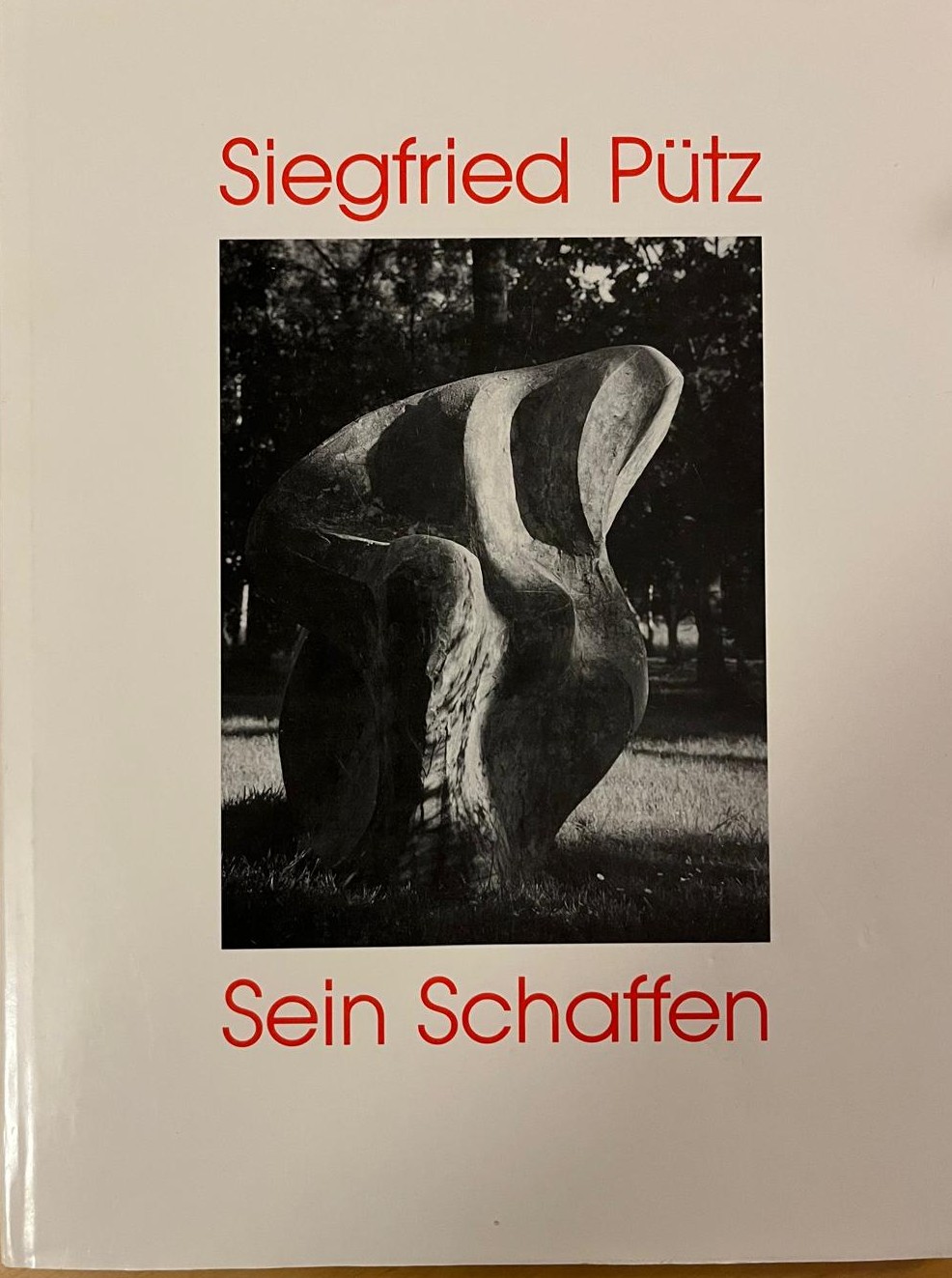
In 2001, a year before her death, Rose-Maria Pütz gave the armchair, along with a table and the drawing Kosmischer Rhythmus (Cosmic Rhythm, 1958, black chalk), to the artist Margaretha Küwen. The handover took place in connection with the book Siegfried Pütz – Sein Schaffen (Siegfried Pütz – His Work), signed by Rose-Maria Pütz, which she presented to Margaretha Küwen with a personal dedication.
Margaretha Küwen and her husband Michael Kohr were closely connected to the Pütz family through their work at the Freie Kunst-Studienstätte Ottersberg (Ottersberg Free Art Study Centre). Rose-Maria Pütz had already written the foreword to Küwen’s book Heilendes Malen (Healing Painting) in 1998.
In January 2026, the armchair was acquired by Katharina Schütte, Margaretha Küwen’s daughter. The drawing Cosmic Rhythm remains in her possession.
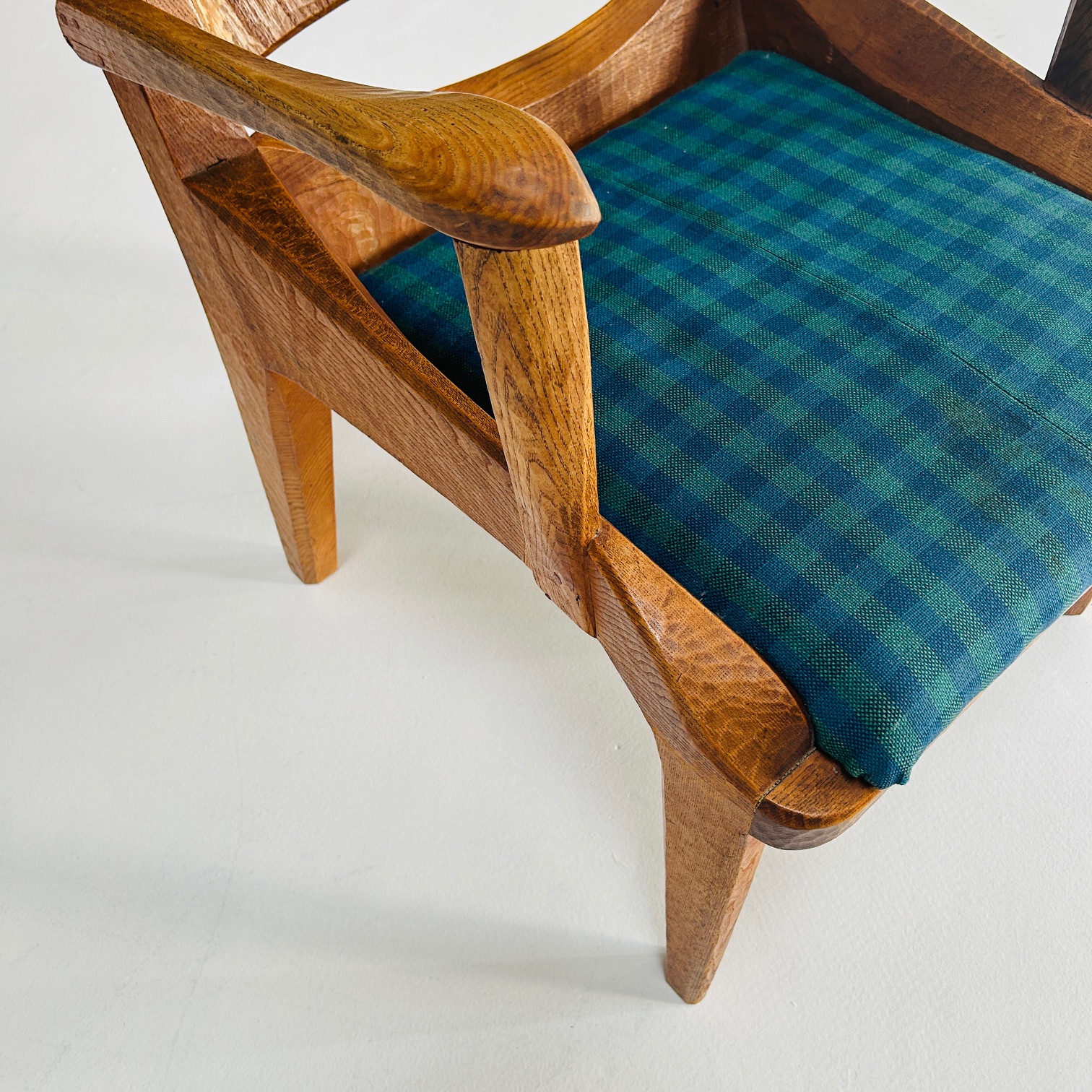
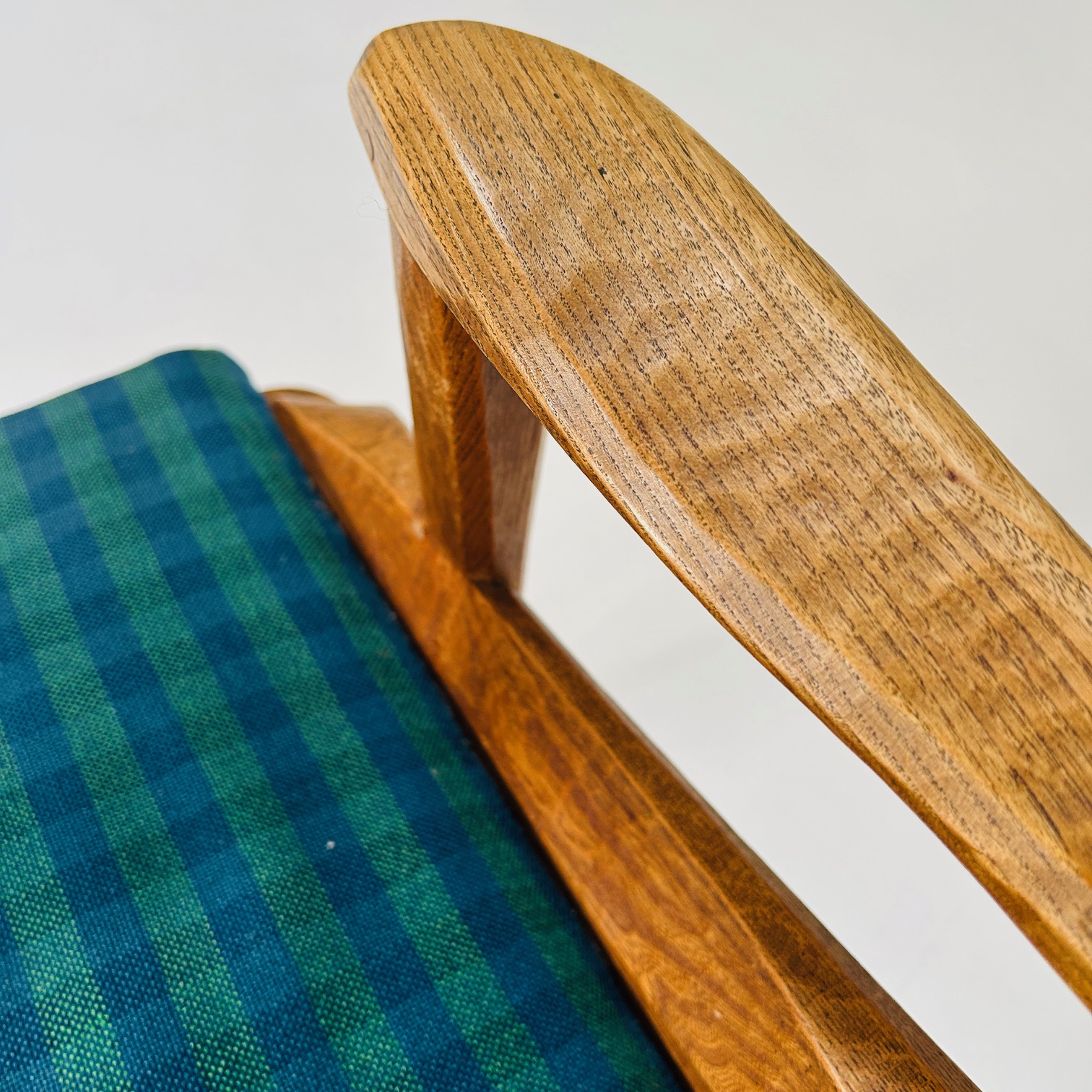
The armchair is made of ash wood, a material often used in the context of anthroposophical furniture design. The surface clearly shows the traces of traditional woodworking with a plane and adze. This treatment gives the furniture a lively, sculptural structure. The wood is simply oiled.
The armchair is largely in its original condition. The seat has two layers of upholstery fabric belonging to the Pütz family. There are also visible signs of older restoration work: a chip has been inserted between the backrest and the rear leg, presumably to close a gap caused by wood shrinkage. The original patina has been partially rubbed off at this point. There is also discolouration on the lower rear leg, which was probably caused by heat exposure.
W 56 H 82 D 62 Hs 43
Armchair by Siegfried Pütz from his private home
Previously owned by Margaretha Küwen and Michael Kohr
Margaretha Küwen studied painting and art therapy at the Ottersberg Free Art School from 1980 to 1984. Her husband Michael Kohr was professor of free painting, graphic design and art theory at the Ottersberg University of Applied Sciences from 1985 to 2009.
The armchair comes from the private home of sculptor, educator and designer Siegfried Pütz (1907–1979). Pütz was born on 15 October 1907 in Berlin and died on 21 February 1979 in Ottersberg. In Berlin, he was one of the first pupils at the Waldorf School. From 1922 to 1924, he attended the Waldorf School in Stuttgart, where he met Rudolf Steiner – a formative experience for his future life and work.
After studying sculpture in Karlsruhe, Pütz continued his training in Dornach, among others with Karl Schubert. Together with the curative educator and Waldorf teacher, he developed what was known as plastic therapy in the early 1930s, an early form of artistic therapy work.
During the Nazi era, Pütz was forced to focus more on designing and manufacturing furniture and everyday objects due to a professional ban. In these works, he took up Rudolf Steiner’s creative impulses and translated them into a contemporary design language.
After the Second World War, Pütz was a craft teacher at the Waldorf School in Ottersberg for eleven years. In the 1960s, he played a key role in the conception of what later became the Ottersberg Free Art Study Centre. The foundation for the future training centre was laid in 1964 in Krefeld with the establishment of the Association of Rudolf Steiner Work and Study Centres for the Social Impact of Art.
In 1967, Pütz coined the term “art therapy” for the first time in the German-speaking world. The term was published in an advertisement in the magazine Erziehungskunst at the start of the first course of study at the study centre. Based on anthroposophical anthropology, Friedrich Schiller’s aesthetic writings and Rudolf Steiner’s remarks on “Goethe as the father of a new aesthetic”, this developed into an independent field of study. In 1984, the institution received state recognition as a university of applied sciences for art therapy and art.
In the 1970s, Siegfried Pütz and his wife Rose Maria Pütz-Nelsen were also involved in founding the Professional Association for Art Therapy on an Anthroposophical Basis, which later became the Professional Association for Anthroposophical Art Therapy (BVAKT).
Rose Maria Pütz-Nelsen (1913–2002) was born on 13 October 1913 in Mönchengladbach. After training as a youth leader, she met the sculptor and arts and crafts teacher Siegfried Pütz in 1937, whom she later married. Together they worked in curative education, initially with young people in industry and later at the Waldorf School in Ottersberg.
In 1965, they jointly founded the Rudolf Steiner Work and Study Centre for the Social Impact of Art. This institution gave rise to the Ottersberg Free Art Study Centre in 1967, which received state recognition as a university of applied sciences for art, art education and art therapy in 1984.